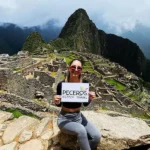
Huayna Picchu forms the prominent peak that rises directly above the Inca City of Machu Picchu. The ascent follows a route constructed during the Inca period and provides direct observation of the site layout and the surrounding Andean terrain. The name Wayna Pikchu in Quechua translates as “Young Mountain” and distinguishes it from the adjacent Machu Picchu mountain (“Old Mountain”). The route is integrated into the visit to Machu Picchu and requires a combined ticket.
Basic Parameters of the Ascent
- Gradient: Moderate to demanding, owing to sustained inclines and narrow sections.
- Distance: Approximately 2.4 kilometres round trip from the trailhead within Machu Picchu.
- Duration: 2 to 3 hours, including time at the summit.
- Elevation gain from the trailhead: Approximately 300 metres.
- Primary features: Observation of Machu Picchu from above and views across the Urubamba River valley.
- Requirements: Specific Machu Picchu + Huayna Picchu ticket with assigned time slot.
Access to the Trailhead
The trailhead is located at the northern sector of Machu Picchu, near the Sacred Rock. From the main entrance, the walk through the Inca City takes 15 to 20 minutes.
To reach Machu Picchu itself:
- Train service operates from Poroy or Ollantaytambo stations to Aguas Calientes (1.5 to 3 hours).
- Bus connection from Aguas Calientes to the site entrance (approximately 30 minutes).
The agency arranges all private transportation with its own vehicles for transfers included in organised itineraries. Our local guides, who maintain extensive experience on routes within the Machu Picchu area, accompany visitors from the entrance and provide detailed explanations of the structures encountered en route to the trailhead.
An alternative approach from Aguas Calientes is the Hiram Bingham Trail (approximately 2 hours on foot), though the bus option is commonly selected when the Huayna Picchu ascent forms part of the day.
Acquisition of the Ticket
The Machu Picchu + Huayna Picchu ticket grants access to both the Inca City and the ascent. Two time slots are available:
- Group 1: 7:00–8:00 am
- Group 2: 10:00–11:00 am
The earlier slot is often preferred for weather and visitor distribution. Tickets are limited to approximately 350 per day and are available only through the official system. Advance purchase several months ahead is required, particularly for the period May to September. The passport used at purchase must be presented at both the Machu Picchu entrance and the Huayna Picchu trailhead. Tickets are non-transferable.
Recommended Period for the Ascent
The interval from April to October corresponds to reduced precipitation in the region. Conditions in May and September combine stable weather with moderate visitor numbers. The months of June to August record the highest attendance, which affects availability. Preparation for variable conditions remains necessary year-round.
Characteristics of the Route
The ascent from the trailhead to the summit requires approximately one hour. Descent takes 40 to 60 minutes. The path consists of original Inca stone steps, narrow sections, and areas with support cables installed for safety. A particular sequence of steep, narrow steps forms part of the historic construction and requires careful footing.
Archaeological studies indicate that the mountain held ceremonial importance. Structures along the route, including terraces and platforms, reflect adaptation to the terrain and integration with the broader sacred landscape. The summit provides an elevated vantage point over Machu Picchu and the adjacent valleys.
Additional Site: Temple of the Moon
At the base of Huayna Picchu, the Temple of the Moon is constructed within a natural cave. This location served ritual purposes during the Inca period. Access adds time to the overall visit but allows examination of the cave architecture and associated features.
Observations from the Summit
The summit area permits observation of the spatial organisation of Machu Picchu below, the course of the Urubamba River, and the enclosing Andean ridges. This perspective illustrates the topographic setting selected for the site.
Our local guides, who possess extensive experience on the Huayna Picchu route and within the Machu Picchu area, conduct the ascent and supply detailed commentary on the construction techniques, the ceremonial role of the peak, and its relation to the Inca City.
The information presented outlines standard considerations for the Huayna Picchu ascent as part of a visit to Machu Picchu. Each schedule remains subject to individual preparation and prevailing conditions.